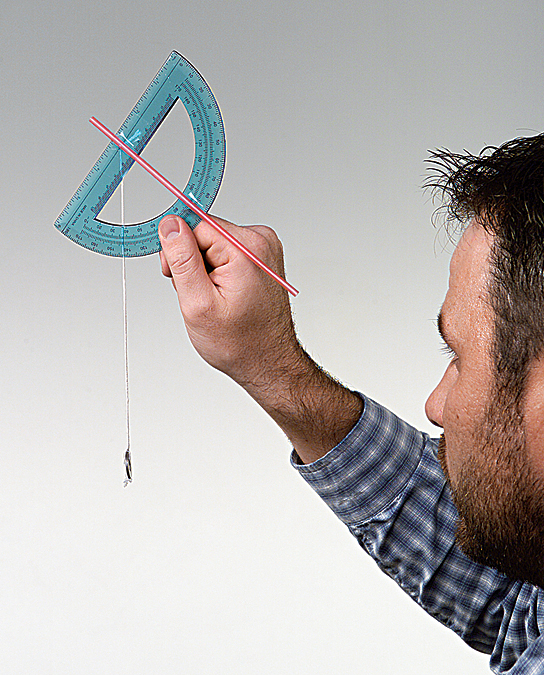
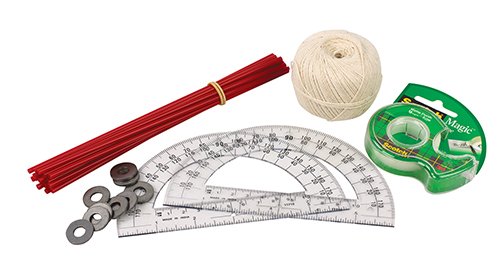
With the Make Your Own Clinometer Laboratory Kit for environmental science, create your own clinometer and use your instrument to measure the height of various objects.
Your class is hiking on a field trip and comes to a large hill. Just how much higher is the top of the hill from your current position? With these handy clinometers, students can indirectly measure the height of tall objects such as hills, trees, and buildings. If the distance from the instrument to the base of the object is known, then the height of the object can be determined using the laws of geometry that govern triangles. Students construct their own clinometers and then use their instruments to determine the height of various objects, indoors or out. Clinometers may also be used as altitude finders for model rockets. Includes complete instructions with reproducible student worksheets, detailed background information, and valuable Teacher Notes. Complete for 30 students working in pairs.
Correlation to Next Generation Science Standards (NGSS)
Science & Engineering Practices
Asking questions and defining problems Planning and carrying out investigations Analyzing and interpreting data Using mathematics and computational thinking Constructing explanations and designing solutions Engaging in argument from evidence
Disciplinary Core Ideas
MS-ETS1.A: Defining and Delimiting Engineering Problems HS-ETS1.A: Defining and Delimiting Engineering Problems
Crosscutting Concepts
Scale, proportion, and quantity
Performance Expectations
HS-PS1-3: Plan and conduct an investigation to gather evidence to compare the structure of substances at the bulk scale to infer the strength of electrical forces between particles.